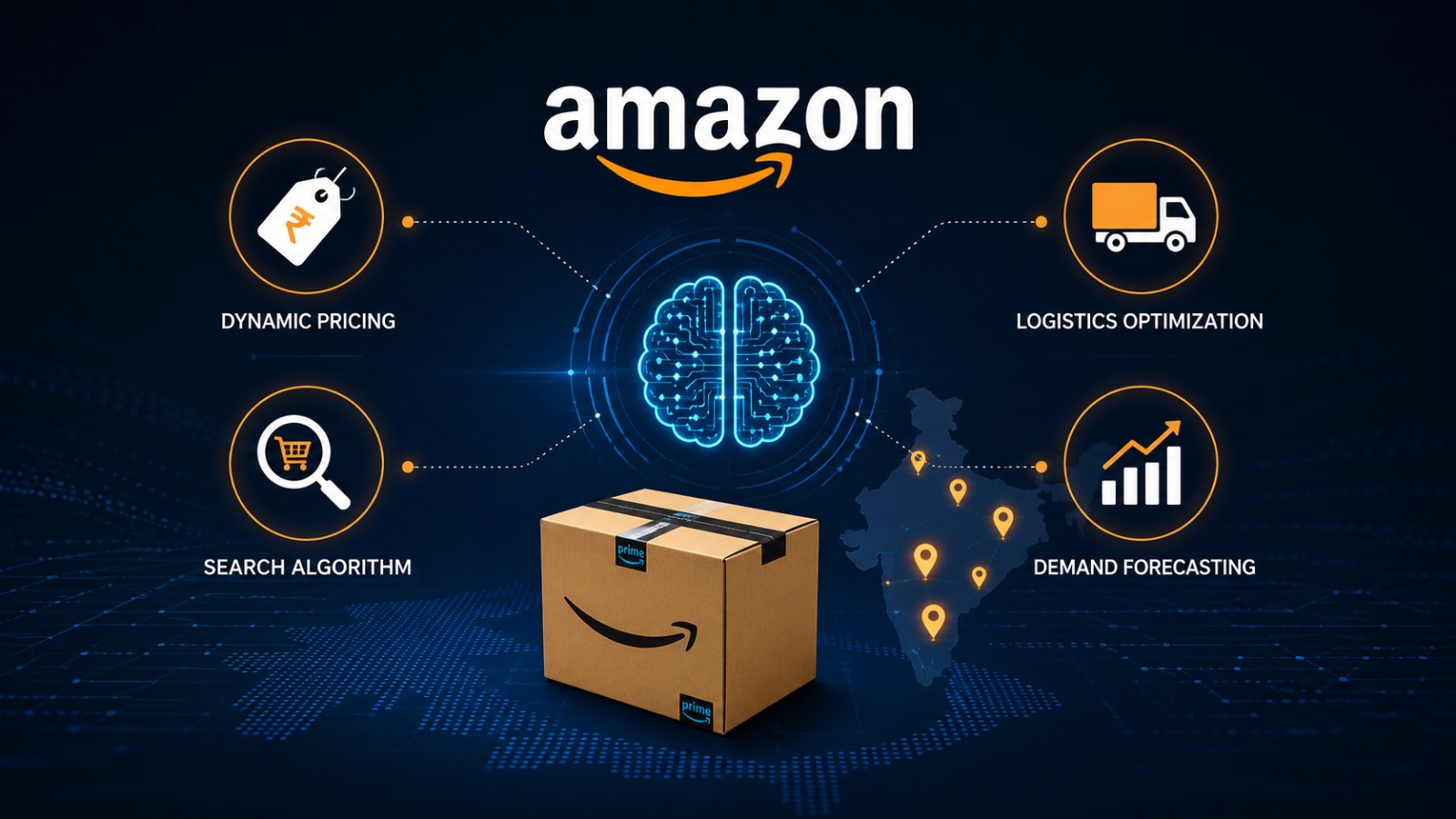
Amazon Machine Learning Case Study: Pricing, Search & Logistics in India
Discover how Amazon uses machine learning for dynamic pricing, product search ranking, and logistics optimization in India. A real-world ML case study with practical takeaways for professionals.
RV
Ravi Vohra
20 Jul 2026
44 min read
How Amazon Uses Machine Learning for Pricing, Search & Logistics in India
A customer in Lucknow searches for a pressure cooker. Within 300 milliseconds, Amazon ranks 80,000 matching products and shows the top 20.
Simultaneously, a warehouse in Hyderabad predicts that same pressure cooker will sell out in three days and triggers a restock order. A delivery station in Pune calculates the optimal route for 400 packages going to 47 different pin codes. The price of a phone charger quietly adjusts by 12 rupees based on competitor movement detected seconds ago.
None of this involves human decisions. Every single action runs on machine learning models trained on billions of past transactions. And this isn't happening in Seattle or Silicon Valley. It's happening across Amazon's India operations, which have grown into the company's second-largest market outside North America.
Here's what most people miss. Amazon's real competitive advantage isn't the website. It's the thousands of ML models running behind every search, price tag, and delivery truck. This Amazon machine learning case study breaks down exactly how those models work in pricing, search, and logistics, specifically in the Indian market.
The Company and Its India Scale
Amazon launched in India in 2013. The market was already crowded. Flipkart dominated. Snapdeal was well-funded. Local players had years of head starts.
A decade later, the landscape looks different. Amazon India serves customers across 100 percent of serviceable pin codes. It hosts over 1.2 million sellers. Its fulfillment network spans dozens of warehouses and hundreds of delivery stations. The platform lists more than 200 million products across categories ranging from electronics to groceries.
India presents challenges that don't exist in Amazon's home market. Address systems are inconsistent. Payment preferences skew heavily toward cash on delivery. Margins are thinner because average order values are lower. Language diversity means search queries appear in Hindi, Tamil, Telugu, Bengali, and mixed Hinglish.
Machine learning is not a luxury in this environment. It's the only way to operate profitably at scale.
The Business Problem: Doing Ecommerce in a High-Complexity Market
Ecommerce looks simple from the outside. List products. Take orders. Ship boxes. But India breaks the simplicity at every level.
Pricing is a nightmare. Millions of sellers set their own prices. Competitors change prices hourly. Festivals and seasonal demand swings create wild fluctuations. A product priced correctly at 10 AM might be overpriced by 2 PM if a competitor launches a flash sale.
Search quality is harder because Indian shoppers express intent differently. One user types "cooker" and expects a pressure cooker. Another types "patila" and expects the same thing in Hindi. A third types "best cooker for family of 4" in natural language. The search system must understand all three queries mean roughly the same product category.
Logistics costs are punishing. Delivering a 300-rupee product to a rural address might cost 80 rupees if the route isn't optimized. Return rates on cash-on-delivery orders run higher than prepaid. And address quality varies wildly. "Near the blue building behind the temple" is a real delivery instruction that Amazon India has to handle.
Solving these problems at India's price sensitivity and scale demanded machine learning that goes beyond what off-the-shelf solutions can do.
Why Traditional Rule-Based Systems Failed
Before machine learning became central, ecommerce platforms relied on manual rules.
Pricing rules were simple. Undercut competitors by 2 percent. Set floor prices to protect margins. Flag products that dropped below cost. These rules worked in stable categories with few competitors. They collapsed in categories like mobile phones where dozens of sellers compete and prices change every few minutes.
Search relied on keyword matching. If the query exactly matched words in the product title, the product appeared. Synonyms, spelling errors, and regional language variations broke the system. A search for "chappal" wouldn't show sandals unless sellers explicitly included that word.
Logistics used static route planning. Delivery zones and routes updated weekly or monthly. They couldn't adapt to traffic, weather, or sudden order density changes. The result was longer delivery times, higher costs, and more failed deliveries.
India's market dynamics exposed every limitation of rule-based thinking. The scale was too large. The variables were too many. The margin for error was too thin. Machine learning became necessary.
The Big Idea: A Self-Learning Ecommerce Operating System
Amazon's breakthrough wasn't any single algorithm. It was the idea that pricing, search, and logistics should form a connected, self-learning system.
When a customer searches for a product, the search algorithm learns from what they click and buy. That learning feeds demand forecasts. Demand forecasts inform inventory placement. Inventory placement affects delivery speed. Delivery speed impacts search ranking because faster delivery products get a ranking boost. Pricing adapts based on demand signals, competitor movement, and inventory levels simultaneously.
Each component is a machine learning problem. But the real power is the feedback loop connecting all of them. A change in pricing signals ripples through search, inventory, and logistics within minutes. The system optimizes globally, not locally.
In India, this integration matters even more because the constraints are tighter. Lower margins mean pricing models can't afford error. Diverse language searches mean ranking models need more sophisticated natural language understanding. Complex logistics mean route optimization has to factor in variables that a static map can't capture.
How It Actually Works: Three ML Systems Explained
Let's walk through each system separately. They connect in production but have distinct architectures.
1. Dynamic Pricing Engine
Amazon does not set retail prices directly because marketplace sellers control final pricing. But Amazon's algorithms influence pricing in three major ways.
First : automated repricing tools for sellers. Sellers can opt into algorithms that adjust their prices based on competitor movement, demand signals, and Buy Box probability. These tools use reinforcement learning to balance margin preservation with competitive positioning. A seller's coffee mug might get repriced from 349 to 329 rupees because the algorithm detects a competitor at 335 and calculates that the lower price increases Buy Box probability by 28 percent.
Second : the Buy Box algorithm itself. When multiple sellers list the same product, Amazon's system chooses which seller gets the "Add to Cart" button. Price is a major factor, but not the only one. Delivery speed, seller rating, return history, and stock availability all feed into a machine learning model that predicts which seller is most likely to deliver a good customer experience. This creates implicit pricing pressure because sellers competing for the Buy Box adjust prices to improve their score.
Third : Amazon's own retail pricing. For products Amazon sells directly, ML models forecast demand elasticity. How much does demand increase if the price drops by 5 percent? How much margin can be preserved before sales volume drops? These models are trained on years of transaction data and update pricing continuously.
The Indian market adds complexity. Festivals like Diwali, Dussehra, and regional celebrations create demand spikes that models must anticipate. Price sensitivity varies by tier-two and tier-three cities where purchasing power differs from metros. Cashback offers, bank discounts, and EMI options interact with base prices in ways the model must factor in.
2. Search and Product Ranking
Amazon's search engine, known internally as A9, processes millions of queries daily in India. It handles English, Hindi, Hinglish, Tamil, Telugu, Kannada, and several other languages.
The query understanding layer uses natural language processing. A query for "bache ke liye joote" translates semantically to "children's shoes." The system recognizes that the intent is footwear for kids, not a literal word match on the Hindi phrase. Misspelled queries like "samsang phone" correctly route to Samsung products. Queries mixing languages like "red color ka dress" get parsed for the combined intent.
Product ranking follows query understanding. For a given search, the model ranks products based on relevance, but relevance is defined through multiple dimensions. Historical click-through rate on similar queries. Conversion rate. Product ratings and reviews. Delivery speed to the customer's location. Return rate for the product category. Seller performance metrics.
The ranking is personalized. A customer who consistently buys premium brands sees different rankings than someone who sorts by lowest price first. A customer in Mumbai might see products from nearby warehouses ranked higher, reducing delivery time. A customer who has returned multiple electronics purchases might see products with higher reliability scores ranked higher.
Everything is learned from data. There is no manual curation. The model's objective function is designed around long-term customer satisfaction, not short-term conversion. Products that generate returns, complaints, or negative reviews get demoted automatically even if they have high click rates.
For Indian languages, Amazon has invested in neural machine translation and transliteration models specifically trained on Indian language data. Voice search in Hindi and Tamil adds another layer of speech-to-text processing before the query even reaches the ranking model.
3. Logistics and Supply Chain Optimization
Amazon India's logistics network is one of the largest private delivery operations in the country. Machine learning touches every part of it.
Demand forecasting happens at the product level, pin code level, and day level. Models predict how many units of a specific phone charger will be ordered from a specific Bangalore pin code next Tuesday. These forecasts are trained on historical order data, seasonality, ongoing promotions, and even weather forecasts. Monsoon rains in Mumbai shift demand patterns, and the models account for it.
Inventory placement follows demand forecasts. Products predicted to sell in a region are moved to nearby fulfillment centers before orders arrive. This reduces delivery distance and time. The placement algorithm balances storage costs against delivery speed. A slow-moving product might stay in a central warehouse. A fast-moving product gets distributed to multiple regional centers.
Route optimization is the final mile challenge. Delivery partners receive optimized routes that minimize travel distance while respecting delivery time windows. The routing models ingest real-time traffic data, road conditions, and order density. A delivery partner in Jaipur might receive a route that adjusts dynamically if traffic near the old city spikes unexpectedly.
Address standardization is a uniquely Indian ML problem. Customer-entered addresses contain abbreviations, landmarks, directional phrases, and mixed languages. Amazon's address parsing models standardize these into structured formats that logistics systems can process. "Shop 5, opp. railway station, near SBI bank" gets resolved into a geocoded location with high confidence through models trained on millions of successfully delivered packages.
Delivery time promises shown on product pages are ML-generated. When a product page says "Get it by tomorrow," that promise reflects a model that has calculated inventory availability at the nearest fulfillment center, distance to the customer, current delivery load, and historical delivery success rate for that pin code. Breaking that promise costs customer trust, so the model errs conservatively.
Business Results: The India Impact
Amazon does not break out India-specific ML performance metrics publicly. But the business outcomes are visible through multiple signals.
Amazon India has become profitable at the operating level, a milestone achieved in part through cost efficiencies that ML drives. Shipping costs as a percentage of revenue have declined steadily as route optimization and inventory placement have improved.
Delivery speed has improved dramatically. Prime-eligible products now reach over 90 percent of serviceable pin codes with one-day or two-day delivery promises. This coverage expanded significantly during the period when Amazon invested in ML-driven supply chain optimization.
The marketplace has grown to over 1.2 million sellers, many from tier-two and tier-three cities. Automated pricing tools and ML-driven seller recommendations have lowered the barrier for small businesses to sell online profitably.
Customer satisfaction metrics tracked through reviews and repeat purchase rates have risen. Better search relevance means customers find what they want faster. Better pricing means they get competitive deals. Better logistics means packages arrive when promised.
Industry reports estimate that ML-driven pricing optimization can improve ecommerce margins by 2 to 5 percent. Search relevance improvements typically boost conversion rates by 10 to 15 percent. Route optimization reduces last-mile delivery costs by 15 to 25 percent. At Amazon India's scale, these percentages translate into hundreds of millions of dollars annually.
Why This Strategy Worked in India
Amazon's ML success in India isn't just about technology. Several structural decisions enabled it.
Data localization and India-specific model training made a genuine difference. Models trained purely on US or European data fail on Indian queries, Indian addresses, and Indian buying patterns. Amazon invested in India-specific training data, language models, and feature engineering.
Integration across pricing, search, and logistics created compounding benefits. Each system's output improved the inputs of the others. This system-of-systems approach is harder to replicate than any single algorithm.
Scale created a data moat. Every transaction, search, and delivery adds training data that improves models. Competitors with smaller transaction volumes have inherently noisier training signals.
Seller enablement through ML tools created a network effect. Sellers who succeed through Amazon's pricing and inventory tools invest more in the platform, increasing selection and competitive pricing, which attracts more customers.
Hidden Challenges and Limitations
The systems are powerful but not flawless.
Algorithmic pricing can create unintended consequences. Sellers using automated repricing occasionally engage in price wars that drive prices below cost for short periods. Amazon has implemented guardrails, but edge cases still occur.
Search personalization raises questions about fairness. Small sellers sometimes struggle for visibility because the ranking model favors products with more purchase history, which established sellers naturally have. Amazon provides advertising tools to compensate, but organic visibility remains a challenge for new entrants.
Address parsing still fails for extreme edge cases. Very rural locations with non-standard addresses sometimes result in delivery failures despite high overall accuracy. The long tail of Indian addresses is genuinely difficult to standardize.
Data privacy concerns grow as personalization deepens. Amazon's systems know customer shopping patterns at an intimate level. The company operates within India's data protection framework, but the breadth of behavioral tracking makes some users uncomfortable.
Regulatory scrutiny adds another layer. India's ecommerce regulations restrict inventory-based pricing and preferential seller treatment. Amazon's ML systems operate within these constraints, but the legal landscape evolves and models must adapt.
What Professionals Can Learn
This case study teaches practical lessons for machine learning practitioners.
ML in production is about systems, not models. A brilliant pricing algorithm means nothing without the data pipeline, feature store, monitoring, and feedback loop that keeps it running. Amazon's success comes from engineering discipline, not algorithmic novelty.
Local data matters enormously. Models that work in one market often fail in another because user behavior, language, and infrastructure differ. Investing in market-specific training data is not optional for global applications.
The business objective function determines everything. Amazon's search model doesn't optimize for clicks. It optimizes for long-term customer satisfaction. That choice shapes the training data, features, and evaluation metrics. Getting the objective right is the hardest and most important decision in any ML project.
Cross-functional integration multiplies impact. Pricing, search, and logistics models that share signals perform better than isolated systems. ML teams that collaborate across domains create more value than teams that optimize locally.
A Practical Framework: The Connected ML System Blueprint
Based on Amazon's approach, here is a 5-step framework for building interconnected ML systems.
Step 1: Identify System Connections
Map how your ML domains interact. Pricing affects demand. Demand affects inventory. Inventory affects delivery. Draw the connections before building the models.
Step 2: Build Shared Data Infrastructure
Create a unified feature store that pricing, search, and logistics models can all access. Invest in data quality and freshness. The models are only as good as their shared inputs.
Step 3: Start Simple, Then Connect
Build individual models first. A pricing model. A search ranking model. Get each working independently. Then connect them through shared signals and feedback loops.
Step 4: Define Cross-System Objectives
A pricing model shouldn't just maximize margin. It should consider the downstream impact on search ranking and delivery load. Define objectives that span systems, not just local metrics.
Step 5: Monitor and Retrain Continuously
Ecommerce environments shift constantly. Competitor behavior, seasonal demand, and user preferences all drift. Automated retraining pipelines and anomaly detection prevent model degradation.
Skills Required to Build Similar Systems
If Amazon's ML infrastructure interests you, focus on these skills.
Python is the foundation. Pandas and NumPy for data manipulation. Scikit-learn for baseline models. TensorFlow or PyTorch for deep learning components. Production code matters as much as experimental notebooks.
SQL is essential for querying transaction data, building training datasets, and validating model outputs. At ecommerce scale, efficient queries are as valuable as clever models.
Machine learning fundamentals span multiple domains. Supervised learning for demand forecasting and ranking. Reinforcement learning for pricing and experimentation. NLP for search and query understanding. Time series modeling for logistics and inventory.
Cloud platform knowledge is practical. AWS SageMaker for model training and deployment. S3 and Redshift for data storage. Lambda for serverless inference. Understanding the infrastructure enables independent project execution.
Statistics and experimentation design round out the toolkit. A/B testing validates whether a model change actually improves business outcomes. Causal inference methods help separate correlation from causation in observational data.
Conclusion
Amazon's machine learning systems in India solve problems that no rulebook could handle. Pricing millions of products in real time. Understanding search queries in a dozen languages. Routing packages through chaotic traffic to inconsistent addresses.
Each system is impressive on its own. But the real achievement is the integration. Pricing decisions inform search rankings. Search behavior feeds demand forecasts. Demand forecasts optimize logistics. The whole is genuinely greater than the sum of its parts.
For machine learning professionals, the lesson is clear. Building models is the easy part. Building systems that learn, connect, and improve continuously is where the value lives.
If building real-world ML systems like these excites you, SkillsYard's Data Science & AI Program covers machine learning, NLP, deep learning, and MLOps through hands-on projects modeled on companies like Amazon.
Sometimes understanding how one connected system works teaches more than a dozen isolated tutorials. If you're still exploring, a free demo session is a simple way to see if practical ML training aligns with your goals.
Related Courses
Data Science & Analytics
BEGINNER
Advance Certification in Power BI
Master Power BI with advanced data modeling, interactive dashboards, and automation. Build business intelligence and reporting skills within 3 months.
Power BIData VisualizationDAXData ModelingDashboard Design
3 months
BEGINNER
Advance Certification in Python for Data Science
Accelerate your career with Python! Master Pandas and Scikit-learn in 6 months, build your portfolio, and land a data science job.
PythonNumPyPandasMatplotlib & SeabornScikit-learn
3 months
INTERMEDIATE
Advance Certification in SQL
Accelerate your career by mastering advanced SQL. Gain expertise in complex querying, performance optimization, and database management in just six months to unlock new job opportunities.
Accelerate your career with Data Analytics! Master SQL, Power BI, Tableau, and Excel in 1 year, build a strong portfolio, and land your dream analytics job.
Data AnalyticsSQLPower BITableauExcelPython
12 months
ADVANCED
Advance Program in Data Science
Unlock your career in Data Science! Master statistics, machine learning & deep learning in 2 years and build predictive solutions for the future.
Data SciencePythonR ProgrammingMachine LearningDeep LearningArtificial Intelligence
16 months
ADVANCED
Advance program in machine learning
Unlock your career in Machine Learning! Master supervised & unsupervised learning, deep learning, NLP, and reinforcement learning in 2 years, building real-world AI solutions.